doe email 2026-27

The Rising Importance of Email in Modern Communication and Digital Business


Introduction

In the rapidly evolving digital landscape, email has remained one of the most influential and dependable communication tools. Despite the emergence of social media platforms, instant messaging applications, and collaborative workplace software, email continues to play a central role in professional correspondence, marketing strategies, and organizational communication.

Since the invention of Email, the system has transformed the way individuals and organizations exchange information. What once required physical letters delivered through postal services can now occur instantly across continents. From corporate announcements and academic discussions to promotional campaigns and customer support, email serves as a universal medium that connects people in nearly every industry.

Today, billions of emails circulate daily, illustrating how deeply embedded this technology has become in modern life. For businesses, professionals, and digital entrepreneurs, understanding the strategic importance of email is essential for success in an increasingly interconnected world.


The Evolution of Email Communication

Email began as a relatively simple tool designed to send digital messages between computers. Over time, however, it evolved into a sophisticated communication infrastructure capable of handling multimedia attachments, automated workflows, and large-scale marketing campaigns.

The early development of email systems occurred during the expansion of computer networks in the late twentieth century. As internet access expanded globally, email quickly became a preferred method for communication because it was faster, more convenient, and far less expensive than traditional mail.

With the introduction of widely used platforms such as Gmail, Microsoft Outlook, and Yahoo Mail, the accessibility of email increased dramatically. These services enabled users to store large volumes of messages, organize correspondence efficiently, and access their inbox from multiple devices.

Today, email has evolved far beyond simple messaging. It now integrates with customer relationship management systems, marketing automation platforms, and data analytics tools, allowing businesses to track user engagement and tailor communication strategies with remarkable precision.


Why Email Remains Essential in the Digital Age

Although communication technologies have diversified, email continues to hold a unique position due to several key advantages.

1. Universal Accessibility

Almost every internet user possesses at least one email address. This widespread adoption ensures that email remains a reliable communication channel regardless of geographic location or technological preference.

2. Professional Credibility

In professional environments, email provides a formal structure for communication. Official messages, business proposals, project updates, and contractual documents are frequently transmitted via email because it allows for clear documentation and record keeping.

3. Asynchronous Communication

Unlike phone calls or live chats, email does not require immediate response. Recipients can review messages at their convenience, making it particularly useful for global teams working across multiple time zones.

4. Documented Record

Email creates an easily searchable record of conversations and decisions. This documentation is valuable for businesses, legal purposes, and project management.


Email as a Core Component of Digital Marketing

One of the most influential uses of email today is within the field of digital marketing. Organizations leverage email campaigns to maintain communication with customers, promote products, and strengthen brand relationships.

Compared with many advertising channels, email marketing offers exceptional cost efficiency. A single well-crafted message can reach thousands of subscribers simultaneously while maintaining a personalized tone.

Successful email marketing campaigns typically involve several strategic elements:

  • Audience segmentation

  • Compelling subject lines

  • Engaging content

  • Clear calls to action

  • Performance tracking

These components enable businesses to deliver targeted messages that resonate with specific audiences.


The Role of Personalization in Email Marketing

Modern consumers expect communication that reflects their interests and needs. Personalization has therefore become a critical aspect of effective email campaigns.

By analyzing customer data—such as browsing behavior, purchase history, and demographic information—companies can tailor messages to individual recipients. This approach improves engagement rates and strengthens relationships between brands and consumers.

For example, an online retailer may send personalized product recommendations based on previous purchases, while a travel company might deliver destination suggestions tailored to a subscriber’s past searches.

Such targeted communication demonstrates attentiveness and relevance, increasing the likelihood that recipients will respond positively to the message.


Best Practices for Writing Effective Emails

Crafting an effective email requires more than simply conveying information. Professional messages should be structured clearly, written concisely, and tailored to the intended audience.

Use Clear Subject Lines

The subject line determines whether a recipient opens the message. It should be informative, concise, and relevant to the email’s content.

Maintain Professional Tone

Polite and respectful language enhances credibility and ensures that communication remains constructive.

Keep Content Organized

Short paragraphs, bullet points, and clear headings improve readability, particularly for busy professionals who may skim messages quickly.

Include a Call to Action

If the email aims to prompt a response, the desired action should be clearly stated.

Proofread Before Sending

Errors in grammar or spelling can undermine professionalism and create misunderstandings.


Email Security and Privacy Considerations

As email usage has grown, so too have concerns regarding cybersecurity and privacy. Organizations must implement measures to protect sensitive information transmitted through email systems.

Common security practices include:

  • Encryption of messages and attachments

  • Multi-factor authentication for accounts

  • Spam filters to detect malicious content

  • Employee training to recognize phishing attempts

Maintaining strong security protocols helps safeguard both businesses and individuals from potential cyber threats.


The Impact of Mobile Technology on Email Usage

The widespread adoption of smartphones has significantly changed the way people interact with email. Messages are no longer confined to desktop computers; users can now read and respond to emails from virtually anywhere.

This mobility has influenced the design of email campaigns and professional messages. Content must now be optimized for smaller screens, ensuring that text remains readable and links are easy to access on mobile devices.

Many organizations therefore prioritize mobile-friendly email design, which includes responsive layouts, concise text, and prominent action buttons.


Automation and Artificial Intelligence in Email

Technological advancements have introduced sophisticated tools that automate many aspects of email communication.

Marketing automation platforms allow businesses to schedule campaigns, send welcome messages to new subscribers, and trigger follow-up emails based on user behavior. These automated sequences enable organizations to maintain consistent engagement without manual intervention.

Artificial intelligence also contributes to improved email performance. Algorithms analyze user interactions to determine optimal sending times, predict subscriber interests, and recommend content strategies.

As these technologies continue to evolve, email communication will likely become even more personalized and efficient.


Challenges Associated With Email Overload

While email offers numerous advantages, excessive volume can present challenges. Many professionals receive dozens—or even hundreds—of messages each day, leading to what is commonly known as email overload.

This phenomenon can reduce productivity and increase stress if messages accumulate faster than they can be addressed.

Strategies to manage email overload include:

  • Organizing messages into folders or labels

  • Prioritizing important correspondence

  • Scheduling dedicated time for email review

  • Unsubscribing from unnecessary mailing lists

These practices help maintain a manageable inbox and improve overall efficiency.


The Future of Email Communication

Despite predictions that newer technologies might replace email, the platform continues to adapt and evolve. Its flexibility and universal acceptance make it uniquely resilient.

Future developments may include:

  • Greater integration with collaboration tools

  • Enhanced security and authentication methods

  • Improved AI-driven personalization

  • More interactive email content

These innovations will likely strengthen email’s role within both professional communication and digital marketing ecosystems.


Conclusion

Email remains one of the most powerful and enduring tools in modern communication. From its origins as a simple messaging system to its current status as a cornerstone of business operations and marketing strategies, email has consistently adapted to technological advancements and changing user expectations.

Its global accessibility, professional reliability, and ability to deliver personalized content ensure that it continues to thrive even amid an expanding array of digital communication platforms.

what time is it 2026-27

Daylight Saving Time 2026: When the Clocks Moved Forward and Why It Matters


4

Introduction

Every year millions of people across the United States adjust their clocks to observe Daylight Saving Time, a long-standing practice designed to shift daylight hours and make better use of natural light. In 2026, the annual time change occurred on Sunday, March 8, when clocks moved forward by one hour during the early morning hours.

While this ritual may appear simple—just turning the clock ahead—it carries a deeper historical, social, and economic significance. The idea behind daylight saving time is to extend daylight during the evening by transferring an hour of sunlight from the early morning to later in the day. As a result, people experience longer evenings filled with natural light, although they temporarily lose one hour of sleep on the night the change occurs.

This article explores everything you need to know about daylight saving time in 2026: when it began, why it exists, how it affects daily life, its historical origins, and when the clocks will return to standard time later in the year.


What Is Daylight Saving Time?

Daylight saving time (DST) is a seasonal adjustment to the standard time used in many regions of the world. During DST, clocks are advanced by one hour so that daylight extends further into the evening.

The fundamental objective of this practice is straightforward: to make better use of daylight during the longer days of spring and summer. Instead of sunrise occurring very early in the morning when many people are still asleep, the daylight is shifted to later hours when individuals are more likely to be active.

For example, before the time adjustment in March 2026, sunrise in cities like Boston occurred shortly after 6 a.m., while sunset took place in the late afternoon. After the clocks advanced by one hour, sunrise appeared later in the morning, but sunset was also pushed further into the evening. This change created brighter evenings that many people associate with the warmer months.

The process is commonly described with two memorable phrases:

  • Spring Forward – clocks move one hour ahead in spring

  • Fall Back – clocks return one hour backward in autumn

These phrases help people remember the direction of the time change.

https://cdn.shopify.com/s/files/1/0255/9777/1885/files/Daylight-Savings-Time_7d6a49d9-721e-4127-8795-fbc61e66f052.jpg?v=1745476178


When Did Daylight Saving Time Begin in 2026?

In 2026, daylight saving time began on Sunday, March 8, at 2:00 a.m. local time.

At that exact moment, clocks were adjusted forward from 2:00 a.m. to 3:00 a.m., instantly removing one hour from the night. Most people therefore woke up feeling as though they had slept slightly less than usual.

Since 2007, the United States has followed a consistent schedule in which daylight saving time starts on the second Sunday of March and ends on the first Sunday of November. This schedule was established through federal legislation intended to provide longer daylight evenings for a greater portion of the year.

The adjustment applies across most American states, though a few regions—including Arizona and Hawaii—generally remain on standard time throughout the year.


Why Do Clocks Move Forward?

The primary rationale behind daylight saving time is the efficient use of natural light. By shifting the clock forward during spring and summer months, the period of daylight better aligns with the hours when people are awake and active.

This shift offers several practical benefits:

1. Longer Evenings With Natural Light

When sunset occurs later in the evening, people can enjoy outdoor activities after work or school without darkness arriving too early.

2. Reduced Electricity Consumption

Historically, daylight saving time was believed to reduce energy consumption because households required less artificial lighting during the evening.

3. Economic Activity

Extended daylight hours often encourage shopping, travel, recreation, and tourism, which can benefit local economies.

4. Safety Considerations

More daylight during commuting hours may help reduce traffic accidents and improve pedestrian visibility.

Although the effectiveness of these benefits is sometimes debated, daylight saving time remains widely practiced.


The Historical Origins of Daylight Saving Time

The concept of adjusting clocks to conserve daylight dates back centuries, but the modern system emerged in the early twentieth century.

One of the earliest proponents of daylight saving concepts was Benjamin Franklin, who humorously suggested adjusting daily schedules to make better use of sunlight.

However, the idea did not become a formal policy until the early 1900s. Several countries introduced daylight saving time during World War I as a strategy to conserve fuel and energy resources.

In the United States, the system has undergone multiple changes throughout history. Federal legislation eventually standardized the schedule to prevent confusion across states and industries.


Changes to the Daylight Saving Schedule

The rules governing daylight saving time in the United States have evolved over decades.

Before 1987

The time change typically began in late April and ended in October.

1987–2006

Legislation extended the start date to the first Sunday of April.

Since 2007

The modern schedule now begins on the second Sunday of March and concludes on the first Sunday of November.

These adjustments lengthened the daylight saving period by several weeks, giving Americans more evenings with daylight throughout much of the year.


The 1970s Experiment With Year-Round DST

During the energy crisis of the 1970s, lawmakers attempted an unusual experiment: implementing daylight saving time throughout the entire year.

Beginning in January 1974, the United States temporarily adopted a system in which clocks remained advanced even during winter months. The idea was to conserve fuel during a period of rising energy costs.

However, the policy produced mixed reactions. Dark winter mornings created concerns for schoolchildren traveling before sunrise, and public support declined.

As a result, the year-round experiment ended earlier than planned, and the country eventually returned to the seasonal system that continues today.


Do People Lose or Gain an Hour?

When daylight saving time begins in March, people lose one hour of sleep because the clock jumps forward.

At 2 a.m., the time instantly becomes 3 a.m., meaning the night is effectively one hour shorter.

In contrast, when daylight saving time ends in autumn, clocks move backward by one hour, allowing people to gain an extra hour of sleep.

These changes can briefly disrupt sleep patterns and daily routines, though most individuals adjust within a few days.


How Daylight Saving Time Affects Daily Life

Although changing a clock seems minor, the time shift influences many aspects of everyday life.

Sleep Patterns

The sudden loss of an hour can make people feel tired or less alert for a short period.

Work Schedules

Businesses and institutions must synchronize schedules, transportation systems, and digital systems with the new time.

Technology

Most modern devices—including smartphones, computers, and smart watches—adjust automatically using internet time servers.

Travel and Transportation

Airlines, railways, and international travel services must carefully coordinate schedules across time zones to avoid confusion.


Daylight and Seasonal Changes

The transition to daylight saving time occurs shortly before the arrival of the Vernal Equinox, which marks the beginning of astronomical spring in the Northern Hemisphere.

In 2026, the equinox occurs on March 20, roughly two weeks after clocks move forward.

As spring progresses, daylight gradually increases each day until reaching its peak during the summer solstice in June.


When Will Daylight Saving Time End in 2026?

Daylight saving time will conclude on Sunday, November 1, 2026.

At 2:00 a.m. local time, clocks will move back one hour, returning to standard time.

This adjustment brings earlier sunsets and darker evenings as winter approaches. While many people enjoy the additional hour of sleep that night, the earlier sunset often signals the arrival of colder seasons and shorter days.


Regions That Do Not Observe DST

Although daylight saving time applies across most of the United States, several regions follow different rules.

For example:

  • Hawaii remains on standard time throughout the year.

  • Most of Arizona does not observe daylight saving time.

  • Certain U.S. territories also remain on standard time.

These exceptions exist largely because the regions are located closer to the equator, where seasonal daylight changes are less dramatic.


Debates Surrounding Daylight Saving Time

In recent years, policymakers and researchers have debated whether the tradition should continue.

Supporters argue that the system encourages outdoor activity, boosts economic productivity, and provides more daylight for evening recreation.

Critics contend that the clock change disrupts sleep cycles, creates confusion, and may offer limited energy savings compared with modern technology.

Some lawmakers have proposed eliminating the seasonal change entirely, either by adopting permanent standard time or permanent daylight saving time.

Despite ongoing discussions, the current schedule remains in place.


Tips for Adjusting to the Time Change

Adapting to the loss of one hour can be easier with a few simple strategies:

  1. Adjust bedtime gradually during the days leading up to the change.

  2. Expose yourself to natural sunlight in the morning to help reset your body clock.

  3. Maintain consistent sleep routines throughout the week.

  4. Limit caffeine late in the evening to improve sleep quality.

These habits can help reduce fatigue and allow the body to adjust more quickly.


The Broader Impact of Time Changes

Beyond individual routines, daylight saving time influences sectors such as agriculture, aviation, broadcasting, and finance.

Global markets rely on precise timing, meaning international coordination becomes especially important when different countries change clocks on different dates.

Digital systems now manage most time adjustments automatically, making the transition smoother than in earlier decades when people manually reset watches and clocks.

https://wjla.com/resources/media2/16x9/1920/986/center/90/87b8ee3d-0702-43f4-8910-35b13776e793-MOREDAYLIGHT1.png


Conclusion

Daylight saving time remains one of the most recognizable seasonal traditions in the United States. In 2026, the clocks advanced on March 8 at 2 a.m., marking the start of brighter evenings and longer days as spring approaches.

Although the practice requires sacrificing one hour of sleep, it offers extended daylight for work, recreation, and travel throughout the warmer months. The cycle will continue until November 1, 2026, when clocks return to standard time and the nation once again adjusts its daily rhythm.

markwayne mullin 2026-27

Trump Comments on Kristi Noem’s Removal and Questions $220 Million Immigration Campaign

Recent political developments in Washington have drawn national attention after former U.S. President Donald Trump spoke publicly about the removal of Kristi Noem from her position as Secretary of Homeland Security. The decision sparked debate across political circles, particularly because of a costly government advertising campaign encouraging undocumented immigrants to voluntarily leave the United States.

While many observers initially assumed the dismissal was related to Noem’s job performance, Trump suggested that the change was largely strategic. According to his remarks, the decision was influenced by his desire to bring Senator Markwayne Mullin of Oklahoma into the Cabinet.

The situation has raised several important questions about government spending, immigration policy, and political decision-making at the highest levels of leadership.


Leadership Change in the Department of Homeland Security

The Department of Homeland Security (DHS) is one of the most powerful federal agencies in the United States. It oversees border security, immigration enforcement, disaster response, transportation security, and several other national safety responsibilities.

Because of the department’s wide influence, any leadership change tends to attract significant political attention.

Trump’s comments indicated that his decision was not primarily driven by dissatisfaction with Noem’s work. In fact, he described her as a capable official who handled difficult responsibilities during her time in office.

However, he also praised Senator Markwayne Mullin and suggested that bringing him into the Cabinet was an opportunity he did not want to miss.

This explanation has led many political analysts to believe the move was more about strategic political positioning than administrative failure.


Controversy Surrounding a $220 Million Advertising Initiative

One of the major topics linked to Noem’s tenure was a large government campaign aimed at encouraging undocumented immigrants to leave the United States voluntarily rather than face deportation proceedings.

Reports indicated that the campaign cost approximately $220 million, making it one of the most expensive public messaging efforts related to immigration.

The campaign included advertisements and public information messages designed to reach audiences both inside and outside the United States.

Supporters of the initiative argued that voluntary departure could reduce enforcement costs. Deportation operations require significant resources, including law enforcement personnel, detention facilities, and legal procedures.

If individuals chose to leave the country voluntarily, the government could potentially save money and reduce pressure on immigration enforcement agencies.

However, critics questioned whether such an expensive campaign could actually influence migration decisions.


Trump’s Reaction to the Spending

Trump acknowledged that he was not particularly pleased with the size of the advertising budget.

In comments reported by media outlets, he suggested that he had not been fully aware of the scale of the campaign when it was approved.

He also compared the cost to his own political campaign expenses, implying that such a large amount of money could have been used more effectively elsewhere.

This criticism added fuel to an already intense political debate about government spending and immigration strategy.


Congressional Hearing and Senate Questions

The issue became even more prominent when Kristi Noem appeared before members of the U.S. Senate during a congressional hearing.

Lawmakers questioned her about the advertising campaign, particularly focusing on how the contracts were awarded and whether the procurement process allowed sufficient competition among vendors.

One senator specifically asked whether the administration had carefully reviewed the financial implications before approving such a large project.

Noem responded by explaining that the campaign was part of a broader strategy designed to communicate immigration policies clearly and discourage illegal entry into the country.

She also stated that the administration believed the campaign could serve as a deterrent by informing potential migrants about the consequences of remaining in the United States without legal authorization.


Immigration Enforcement and Border Policy

Immigration remains one of the most complex and politically sensitive issues in the United States.

For years, policymakers have debated the best way to balance border security, economic needs, and humanitarian concerns.

Supporters of stricter immigration enforcement argue that strong policies are necessary to maintain national sovereignty and protect jobs for American citizens.

Opponents often emphasize the humanitarian aspects of migration, including the challenges faced by families seeking safety or better economic opportunities.

The advertising campaign associated with Noem’s tenure represented a deterrence-based approach, attempting to reduce illegal immigration by sending a clear message about enforcement policies.


The Role of Senator Markwayne Mullin

Senator Markwayne Mullin, whom Trump praised while discussing the leadership change, is known for his strong conservative positions on national policy issues.

Bringing a sitting senator into a Cabinet role can significantly influence the direction of federal agencies.

Such appointments are often viewed as a way to ensure closer alignment between the administration’s policy goals and the actions of government departments.

Political analysts note that appointing trusted allies to key leadership roles can strengthen an administration’s ability to implement its agenda.


Public Reaction and Political Debate

Public reaction to the news has been mixed.

Some political commentators believe the leadership change reflects normal adjustments within an administration seeking to improve efficiency and policy alignment.

Others argue that frequent changes in leadership can create uncertainty within major government institutions.

The debate has also highlighted broader concerns about accountability in government spending.

Many taxpayers expect large federal expenditures to deliver clear and measurable results.

When programs involve hundreds of millions of dollars, questions about oversight and effectiveness naturally arise.


Evaluating the Effectiveness of Government Campaigns

Public communication campaigns are commonly used by governments around the world.

For example, governments frequently launch advertising initiatives to promote public health awareness, road safety, or environmental protection.

However, measuring the success of these campaigns can be challenging.

Experts typically evaluate them by analyzing data such as:

  • Behavioral changes among target audiences

  • Long-term cost savings

  • Improvements in public awareness

In the case of immigration messaging, determining effectiveness can be even more complicated because migration decisions are influenced by many factors including economic conditions, family connections, and political stability in migrants’ home countries.


Broader Implications for U.S. Immigration Policy

The discussion surrounding Noem’s departure and the advertising campaign reflects deeper questions about the future direction of U.S. immigration policy.

Some policymakers believe deterrence strategies are necessary to discourage illegal entry.

Others advocate for reforms that expand legal immigration pathways while addressing humanitarian concerns.

As new leadership takes shape within the Department of Homeland Security, observers will be watching closely to see whether policy priorities shift or remain consistent with previous approaches.


Conclusion

The decision to remove Kristi Noem from the role of Homeland Security Secretary has sparked widespread political discussion.

Although Trump emphasized that the move was not primarily based on dissatisfaction with her work, the controversy surrounding the $220 million immigration advertising campaign has kept the issue in the national spotlight.

The episode highlights several ongoing challenges in American governance, including how to balance effective policy communication with responsible spending of public funds.

2026 winter olympics

2026 Winter Olympics Explained by Numbers: Inside the Milano–Cortina Games

The 2026 Winter Olympic Games, officially known as Milano–Cortina 2026, represent one of the most ambitious and innovative editions in Olympic history. Spanning snow-covered mountains, historic cities, and modern arenas, the Games will unite thousands of athletes and millions of fans for over two weeks of elite winter sport.

From record-breaking geography to sustainability milestones, the Milano–Cortina Olympics are best understood through numbers. Here is a comprehensive, data-driven look at what makes the 2026 Winter Olympics truly historic.


🇮🇹 Italy’s Olympic Legacy: A Return to the World Stage

2The number of times Italy has previously hosted the Winter Olympics

Italy is no stranger to the Olympic spotlight. The country first welcomed the Winter Games in 1956 in the alpine town of Cortina d’Ampezzo, followed by the 2006 Turin Winter Olympics. In addition, Italy hosted the 1960 Summer Olympics in Rome, cementing its place as a nation deeply connected to Olympic history.

The 2026 Games mark Italy’s third time hosting the Winter Olympics, making it one of the most experienced Olympic hosts in Europe.


🏔️ The Most Geographically Expansive Winter Olympics Ever

8,494 square milesThe total area covered by Olympic venues

Milano–Cortina 2026 will set a new record as the most geographically widespread Winter Olympics in history. Events will take place across northern Italy, stretching from the metropolitan heart of Milan to the dramatic alpine landscapes of Cortina d’Ampezzo.

Unlike traditional Games concentrated in one city, this edition embraces a multi-location model, reflecting modern priorities of sustainability and regional inclusion.


🏙️ Two Host Cities, One Olympic Vision

2The number of official host cities

For the first time in Olympic history, the Winter Games will be co-hosted by two cities:

  • Milan – Italy’s global capital of finance, fashion, and innovation

  • Cortina d’Ampezzo – a world-renowned alpine resort and historic Olympic town

The two cities are located approximately 250 miles (400 km) apart, with a travel time of nearly five hours by road. This bold approach allows events to take place in venues best suited to each sport rather than forcing all competitions into one urban center.


🏟️ Venues Designed for Sustainability, Not Excess

13Total number of Olympic competition venues
11Venues that are existing or temporary

One of the defining features of the Milano–Cortina Games is their low-construction philosophy. Out of 13 total venues:

  • 11 will be existing or temporary structures

  • Only two major new developments are required

This strategy significantly reduces environmental impact while avoiding the issue of unused “white elephant” stadiums after the Games.


🏒 A New Arena for Ice Hockey

16,000 seatsCapacity of the new ice hockey stadium

The most significant new construction project for the 2026 Olympics is a state-of-the-art ice hockey arena in Milan, capable of seating approximately 16,000 spectators. Construction has been underway for over two years and is designed to serve as a long-term sports and entertainment venue well beyond the Olympics.


🚆 Olympic Village with a Future Purpose

1,700 unitsStudent housing units planned after the Games

Sustainability extends beyond sports venues. Milan’s Porta Romana railway yard, once abandoned, is being transformed into the Olympic Village. After the Games conclude, the site will be converted into 1,700 student housing units, addressing long-term urban needs rather than temporary use.

This adaptive reuse model reflects the International Olympic Committee’s push toward legacy-driven urban planning.


🌱 A Lower Carbon Footprint Olympics

The distributed hosting model was not chosen at random. According to Olympic organizers, spreading events across existing venues:

  • Reduces the need for large-scale construction

  • Minimizes environmental disruption

  • Lowers overall carbon emissions

By maximizing infrastructure that already exists, Milano–Cortina 2026 aims to become a benchmark for environmentally responsible Olympic Games.


🏅 Athletes, Events, and Global Participation

While final athlete numbers will be confirmed closer to the Games, expectations include:

  • Thousands of athletes from over 90 countries

  • Multiple disciplines across snow and ice sports

  • New and expanded events reflecting the evolution of winter athletics

The Games will once again serve as a platform where emerging talents and seasoned champions compete on the world’s most prestigious winter stage.


📊 Why Milano–Cortina 2026 Matters

The 2026 Winter Olympics are not just another sporting event—they represent a shift in Olympic philosophy:

  • From centralized to distributed hosting

  • From heavy construction to smart reuse

  • From short-term spectacle to long-term urban benefit

By combining tradition with innovation, Italy is redefining how global sporting events can be organized in the 21st century.


🏁 Final Thoughts

The Milano–Cortina 2026 Winter Olympics, viewed through numbers, reveal a Games built on scale, sustainability, and strategic planning. From its record-breaking geography to its environmentally conscious design, the event promises to be both spectacular and responsible.

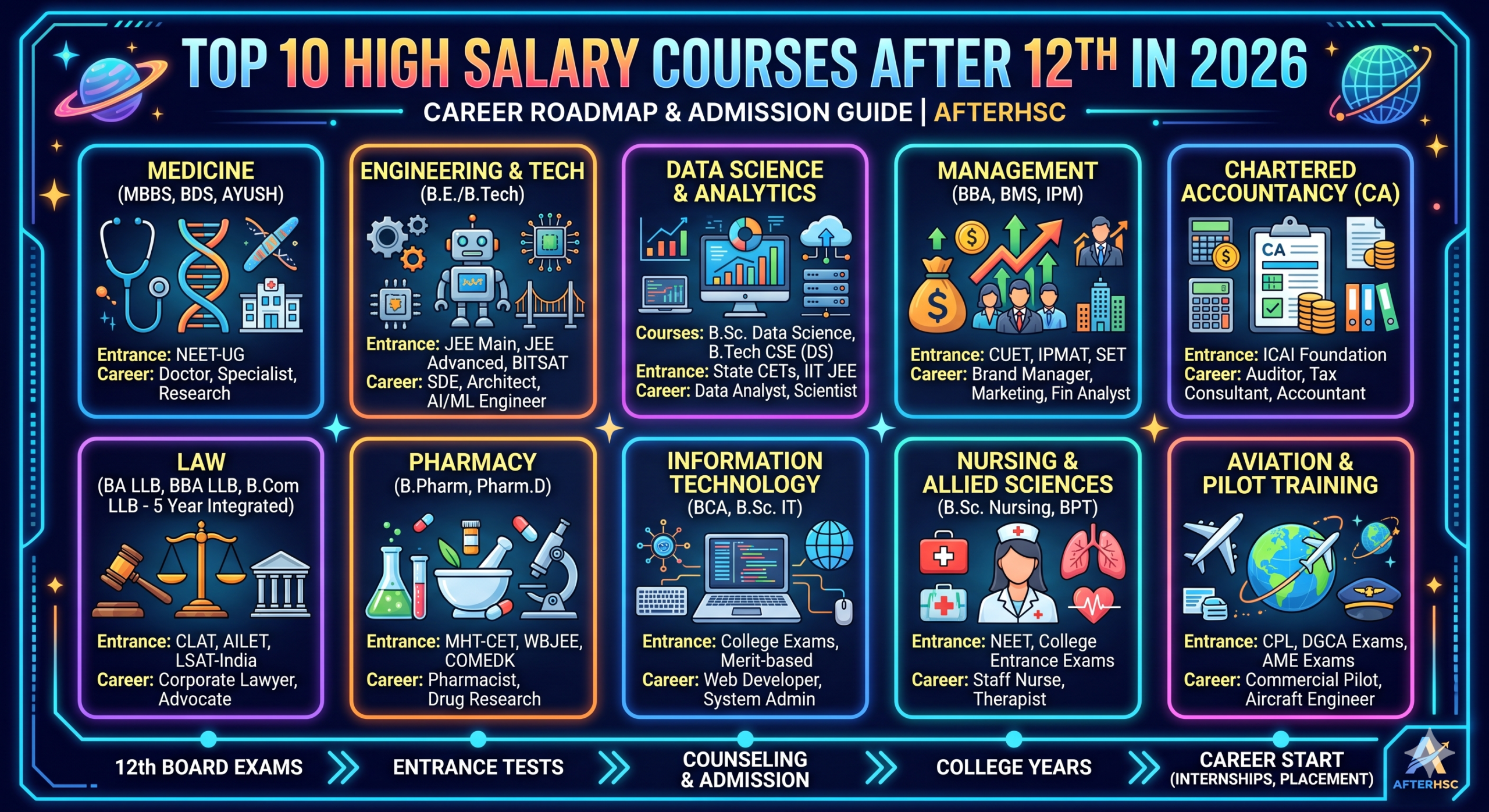
After HSC શું કરવું? સંપૂર્ણ Career Roadmap 2026 - 27

After HSC શું કરવું? સંપૂર્ણ Career Roadmap 2026 

પરિચય: HSC પછીનું જીવન – સૌથી મોટો નિર્ણય

HSC (12મું ધોરણ) પૂર્ણ કરવું એ દરેક વિદ્યાર્થીના જીવનનો મહત્વનો પડાવ છે.
2026માં જ્યાં સ્પર્ધા વધી રહી છે, નવા career વિકલ્પો આવી રહ્યા છે, ત્યાં મોટાભાગના વિદ્યાર્થીઓ એક જ પ્રશ્ન પૂછે છે:

“HSC પછી હવે શું કરવું?”

જો તમે પણ confused છો તો ચિંતા કરવાની જરૂર નથી.
આ લેખમાં તમને Science, Commerce અને Arts – ત્રણેય stream માટે સંપૂર્ણ career roadmap 2026 Gujarati ભાષામાં સરળ રીતે સમજાવવામાં આવશે.


2026માં Career Planning કેમ ખૂબ જરૂરી છે?

આજના સમયમાં માત્ર degree પૂરતી નથી.

Career Planning જરૂરી કેમ?

  • AI અને Automation ઘણા job બદલાઈ રહ્યા છે

  • Skill-based job વધુ demand માં છે

  • Engineering–MBBS સિવાય પણ career options છે

  • ખોટો decision લીધે 2–3 વર્ષ બગડી શકે

👉 HSC પછી યોગ્ય planning = Successful future


Step 1️⃣: Career પસંદ કરતા પહેલા પોતાને સમજો

Career પસંદ કરતા પહેલા પોતાને આ પ્રશ્નો પૂછો:

  • મને કયો subject સૌથી વધુ ગમે છે?

  • Theory કે practical work – શું પસંદ છે?

  • Government job કે private sector?

  • Long-term goal શું છે?

📌 Interest + Skill + Scope = Right Career


Science Students માટે Career Roadmap 2026

Science stream માં options વધારે છે, પણ confusion પણ વધારે હોય છે.


1️⃣ Engineering & Technology Careers

આજની engineering માત્ર Civil–Mechanical સુધી સીમિત નથી.

Best Engineering / Tech Fields 2026:

  • Computer Science / IT

  • Artificial Intelligence & Data Science

  • Cyber Security

  • Cloud Computing

  • Robotics & Automation

💼 Salary: ₹4–12 LPA (experience સાથે વધુ)
🎯 Skills: Coding, logical thinking


2️⃣ Medical Field (MBBS વગર પણ Career)

MBBS નહીં થાય તો medical career બંધ નથી.

Best Medical Careers Without MBBS:

  • BSc Nursing

  • Physiotherapy (BPT)

  • Pharmacy (B.Pharm / D.Pharm)

  • Medical Lab Technology

  • Radiology Technician

🏥 Demand સતત વધી રહી છે
💼 Job security સારી


3️⃣ Pure Science & Research

જો તમને science deeply ગમે છે:

Courses:

  • BSc + MSc

  • Research programs

  • Teaching line

🎯 Career:

  • Scientist

  • Professor

  • ISRO, DRDO, Government labs


4️⃣ Science Students માટે Government Jobs

Science students prepare કરી શકે:

  • SSC

  • Banking

  • Railway

  • Defence (NDA, CDS)

  • State Govt Exams

👉 Degree સાથે preparation best option


Commerce Students માટે Career Roadmap 2026

Commerce હવે માત્ર CA સુધી સીમિત નથી.


1️⃣ Professional Courses

Top Courses:

  • CA (Chartered Accountant)

  • CS (Company Secretary)

  • CMA

💰 High salary + respect
📚 Discipline જરૂરી


2️⃣ Business & Management Careers

Courses:

  • BBA

  • BCom + MBA

  • Entrepreneurship

🎯 Career:

  • Manager

  • Business Analyst

  • Startup Founder


3️⃣ Finance, Banking & Stock Market

Emerging Careers:

  • Financial Analyst

  • CFA

  • Investment Banking

  • Stock Market Trader

📈 Skill-based growth


4️⃣ Commerce Students માટે Government Jobs

  • Banking (SBI, IBPS)

  • SSC (CGL, CHSL)

  • Clerk, Auditor, Tax Assistant


Arts Students માટે Career Roadmap 2026

Arts students માટે પણ bright future છે.


1️⃣ Humanities & Social Science Careers

Subjects:

  • Psychology

  • Sociology

  • Political Science

  • Economics

🎯 Career:

  • Counselor

  • Social Worker

  • Policy Analyst


2️⃣ Creative & Design Careers

High Demand Fields:

  • Graphic Design

  • UI/UX Design

  • Animation & VFX

  • Content Writing

🌍 Freelancing + Global income possible


3️⃣ Law, Journalism & Civil Services

  • Law (5 Year LLB)

  • Journalism / Mass Communication

  • UPSC / GPSC / Civil Services

📌 Arts students competitive exams માં strong હોય છે


Short Term Skill Courses (All Stream Students)

Degree વગર પણ job possible છે.

Best Short-Term Courses 2026:

  • Digital Marketing

  • Web Development

  • Data Analysis

  • Tally & Accounting

  • Video Editing

⏳ Duration: 3–12 months
🎯 Focus: Skill + Job


Government Job Roadmap After HSC

જો job security જોઈએ:

Plan:
1️⃣ Graduation complete કરો
2️⃣ Early exam preparation
3️⃣ Aptitude + GK strong કરો
4️⃣ Mock tests practice

Popular Exams:

  • SSC

  • Railway

  • Police

  • Defence

  • State PSC


HSC પછી Students કરેલી Common Mistakes

❌ Friends ને જોઈ career પસંદ કરવો
❌ Interest ignore કરવું
❌ Skill develop ન કરવી
❌ Proper guidance વગર decision
❌ Time waste કરવો


2026 માટે Final Career Advice

  • Career decision ધીરજથી લો

  • Counseling લો

  • Degree સાથે skill develop કરો

  • Long-term vision રાખો

  • Trend પાછળ blind ન દોડો


Conclusion: HSC પછી તમારું Future તમારા હાથમાં છે

HSC પછી life નો સાચો career journey શરૂ થાય છે.
Best career નથી હોતું – Right career હોય છે.

યોગ્ય planning, skill અને guidance સાથે 2026 તમારું success year બની શકે છે.

👉 વધુ career guidance, updates અને student information માટે
afterhsc.com પર regular visit કરતા રહો.

Top 5 Medical Schools in USA for International Students with Low Tuition Fees 2026-27

Top 5 Medical Schools in USA for International Students with Low Tuition Fees

Studying medicine in the United States is a dream for many international students. The USA is home to some of the world’s most advanced healthcare systems, research facilities, and medical universities. However, one major concern often stops students from applying: high tuition fees.

The good news is that not all U.S. medical schools are extremely expensive. Some universities offer comparatively lower tuition fees, scholarships, and financial aid options, making medical education in the USA more accessible for international students.

In this guide, we will explore the Top 5 Medical Schools in the USA for International Students with Low Tuition Fees, along with admission requirements, estimated costs, and why these schools are popular choices.


Why Study Medicine in the USA as an International Student?

Before we dive into the list, let’s understand why studying medicine in the USA is worth considering:

  • 🌍 Globally recognized medical degrees

  • 🏥 Access to world-class hospitals and clinical training

  • 🔬 Strong focus on research and innovation

  • 💼 High-paying medical careers after graduation

  • 📈 Excellent residency and fellowship opportunities

Despite higher costs compared to some countries, the long-term return on investment (ROI) for U.S. medical graduates is among the highest in the world.


Can International Students Study Medicine in the USA?

Yes, international students can study medicine in the USA, but there are a few important points to know:

  • Only a limited number of U.S. medical schools accept international students

  • Competition is extremely high

  • Strong academic background and MCAT scores are required

  • Proof of financial ability is often needed

That’s why choosing the right medical school with reasonable tuition fees is crucial.


Top 5 Medical Schools in USA for International Students with Low Tuition Fees

1. University of Texas Health Science Center (UT Health San Antonio)

Location: Texas
Type: Public Medical School
Average Tuition (International): Approx. $35,000–$40,000 per year

Why It’s Affordable

Texas public medical schools are known for lower tuition fees compared to private universities, even for international students.

Key Highlights

  • Strong clinical training programs

  • Excellent patient exposure

  • Advanced research facilities

  • Lower cost of living in Texas

Admission Requirements

  • Bachelor’s degree (science background preferred)

  • MCAT score

  • TOEFL/IELTS for non-native English speakers

  • Strong letters of recommendation

📌 Best for students seeking quality education at lower cost


2. University of Mississippi School of Medicine

Location: Mississippi
Type: Public Medical School
Average Tuition (International): Approx. $40,000 per year

Why It’s Affordable

Mississippi has one of the lowest costs of living in the USA, which significantly reduces total expenses.

Key Highlights

  • Focus on primary care and community health

  • Modern medical training facilities

  • Affordable housing and living costs

Admission Requirements

  • Strong undergraduate GPA

  • MCAT score

  • Clinical exposure and volunteering experience

📌 Ideal for students looking for low living expenses


3. University of Arkansas for Medical Sciences (UAMS)

Location: Arkansas
Type: Public Medical School
Average Tuition (International): Approx. $42,000 per year

Why It’s Affordable

Arkansas offers reasonable tuition and low accommodation costs, making it attractive for budget-conscious international students.

Key Highlights

  • Emphasis on hands-on clinical practice

  • Strong residency placement rates

  • Supportive academic environment

Admission Requirements

  • Bachelor’s degree with prerequisite courses

  • MCAT score

  • Proof of English proficiency

📌 Good balance of cost and clinical exposure


4. Texas A&M College of Medicine

Location: Texas
Type: Public Medical School
Average Tuition (International): Approx. $38,000–$45,000 per year

Why It’s Affordable

Texas A&M benefits from state funding, keeping tuition lower than many private medical schools.

Key Highlights

  • Strong focus on rural and community medicine

  • Excellent faculty and research programs

  • Multiple campus locations

Admission Requirements

  • Competitive MCAT score

  • Strong academic record

  • Healthcare-related experience

📌 Best for students interested in community and rural healthcare


5. Howard University College of Medicine

Location: Washington, D.C.
Type: Private Medical School
Average Tuition (International): Approx. $45,000 per year

Why It’s Affordable

Although private, Howard University offers scholarships and financial aid options that reduce overall costs.

Key Highlights

  • Long history of training excellent physicians

  • Strong focus on diversity and inclusion

  • Located near top hospitals and research centers

Admission Requirements

  • Bachelor’s degree

  • MCAT score

  • Strong personal statement and recommendations

📌 Excellent choice for diversity-focused education


Comparison Table: Low-Tuition Medical Schools in the USA

Medical SchoolStateApprox. Tuition (Per Year)Cost of Living
UT Health San AntonioTexas$35k–$40kLow
University of MississippiMississippi~$40kVery Low
UAMSArkansas~$42kLow
Texas A&M College of MedicineTexas$38k–$45kLow
Howard UniversityWashington, D.C.~$45kMedium

Additional Costs to Consider

Even with low tuition, international students should plan for:

  • Living expenses: $10,000–$18,000 per year

  • Health insurance

  • Books and medical equipment

  • Visa and travel expenses

💡 Tip: Choosing a state with a low cost of living can save thousands of dollars annually.


Scholarships & Financial Aid for International Medical Students

While options are limited, some medical schools offer:

  • Merit-based scholarships

  • Need-based financial aid

  • University-specific grants

  • External scholarships from private organizations

Always check the official university website for updated scholarship information.


Is Studying Medicine in the USA Worth It for International Students?

Yes, especially if you consider:

  • High doctor salaries in the USA

  • Global recognition of U.S. medical degrees

  • Opportunities for specialization and research

  • Long-term career growth

Although the initial investment is high, medical professionals in the USA earn some of the highest salaries worldwide, making it a strong long-term choice.


FAQs: Medical Schools in the USA for International Students

❓ Are there fully funded medical scholarships in the USA?

Fully funded options are rare, but partial scholarships and financial aid are available.

❓ Is MCAT mandatory for international students?

Yes, most U.S. medical schools require MCAT scores.

❓ Can international students get residency in the USA?

Yes, but it is competitive. Strong academics and USMLE scores are essential.

❓ Which state is cheapest for medical education?

Texas, Mississippi, and Arkansas are among the most affordable states.


Final Thoughts

Finding low-tuition medical schools in the USA for international students is challenging—but not impossible. With the right research, academic preparation, and financial planning, studying medicine in the USA can become a reality.

If you aim for quality education, global recognition, and high-paying medical careers, the universities listed above offer some of the best value options available.